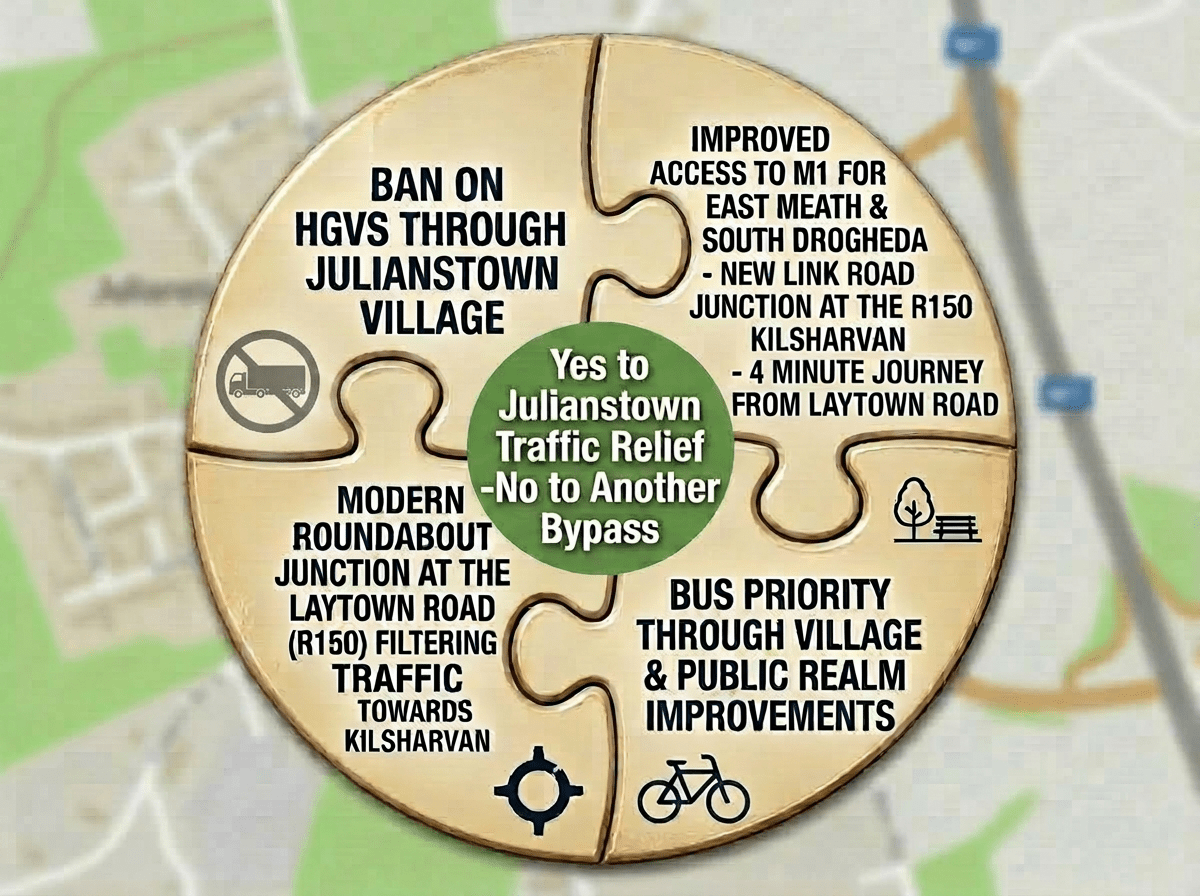
A community campaign group is calling on Meath County Council to pause plans for the Julianstown Traffic Relief Scheme until more information is published about the evidence used to support the project.
The campaign, “Yes to Julianstown Traffic Relief: No to Another Bypass”, says it supports measures to tackle congestion and improve road safety in the village but believes decisions should be based on transparent evidence and that all possible alternatives should be fully assessed before the scheme progresses to its next stage on July 31.
The campaign fully supports the need to address traffic congestion and improve road safety in Julianstown. However, it believes that the process must be based on robust, publicly available evidence and that all realistic alternatives should be objectively assessed before a bypass is advanced. The campaign contends that direct access to the M1 north of Julianstown will achieve better outcomes for the residents of Julianstown and the commuters of East Meath and Drogheda. This can be delivered quickly using the existing road network.
At the centre of the campaign’s concerns is a statement attributed to the project’s traffic study indicating that only approximately 10% of vehicles travelling through Julianstown are doing so to avoid paying the M1 toll.
If correct, this represents a fundamental shift from the long-held understanding of traffic patterns in the area. For many years, toll avoidance has been widely cited by public representatives, residents and planning documents as a significant contributor to traffic volumes through the village. The Meath County Development Plan itself refers to the need for a bypass in the context of traffic diverting through the village to avoid the motorway toll.

Despite the significance of this apparent change, campaign members say that the underlying evidence, methodology and analysis supporting the 10% figure have not yet been made publicly available.
Campaign spokesperson Emma Haran said:
“If the evidence genuinely shows that only 10% of traffic is avoiding the toll, then that is a major finding with significant implications for the entire project. It challenges assumptions that have informed public debate and planning policy for many years. Such a fundamental change must be fully explained, independently scrutinised and made available to the public before the project progresses.”
The campaign believes this raises an important question:
If toll avoidance accounts for only a small proportion of traffic, what are the principal causes of congestion, and have all potential solutions been properly investigated?
Campaign members are calling on Meath County Council to publish the evidence underpinning its conclusions and to demonstrate how all reasonable alternatives have been assessed in accordance with national transport appraisal principles before progressing to the next stage.
“This is not an attempt to delay traffic relief,” the spokesperson said. “It is a call for good planning. Decisions involving major public investment and potentially irreversible impacts on heritage, landscape and communities must be evidence-led, transparent and capable of withstanding independent scrutiny.”
The campaign is also concerned that progressing the project without first addressing these questions risks undermining public confidence in the consultation process.
Accordingly, the group is calling on Meath County Council to:
- Publish the full evidence and methodology supporting the reported finding that approximately 10% of traffic is avoiding the M1 toll.
- Explain how this conclusion aligns with previous planning assumptions and policy documents relating to Julianstown.
- Demonstrate that all feasible traffic relief measures have been assessed in accordance with national transport appraisal guidance.
- Pause progression of the scheme beyond the current consultation stage until this information has been made publicly available and stakeholders have had a meaningful opportunity to consider it.
The campaign continues to support effective traffic relief for Julianstown but believes that the best outcome for East Meath and South Drogheda can only be achieved through a transparent process that commands public confidence.
“Our message is straightforward,” the spokesperson concluded. “We support solving Julianstown’s traffic problems. We simply ask that decisions are based on evidence that is open to public scrutiny before irreversible choices are made.”
We are holding a public meeting on Monday, 20th July at 7.30pm in City North Hotel.