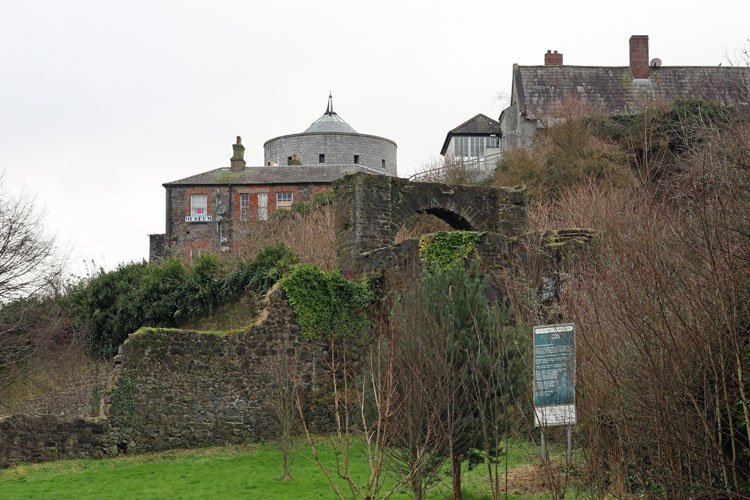
One of Drogheda’s surviving medieval monuments is set to receive some much-needed attention, with Louth County Council agreeing to clear the overgrown area surrounding the Butter Gate.
The historic structure, located close to the John Street dual carriageway and Drogheda Bus Station, forms part of the remains of the town’s medieval defences.
Vegetation around the monument has become heavily overgrown in recent years, making access difficult and limiting people’s ability to get close to the structure.
Following representations from Cllr Pio Smith, Louth County Council now intends to clear the vegetation around the Butter Gate during September.
The work will be funded from the Council’s own resources and is being viewed as the first phase in efforts to improve the setting and accessibility of the monument.
Cllr Smith said he has repeatedly raised the need to maintain and ultimately conserve the site.
“I have consistently raised the issue of maintaining the Buttergate National Monument and even restoring it to its former glory,” he said.
“Phase 1 is agreed. Louth County Council intends to remove the overgrowth of vegetation around the Buttergate in September. The work will be funded by the Council’s own resources.”
Conservation work could follow
More substantial conservation work would require further assessment, planning and funding.
Cllr Smith said the Community Monuments Fund could potentially provide a route towards carrying out future repairs.
“In terms of external funding for actual conservation repairs to the monument, the Community Monuments Fund would probably be most appropriate,” he said.
“In the first instance LCC would have to carry out a full survey, develop a detailed conservation and management plan for the monument and get Ministerial consent to carry out these work, as well as applying for a CMF grant to fund them.”
He said he wants that process to move forward as quickly as possible and intends to seek funding during the Council’s September budget discussions.
“I have proposed that we move on this as soon as possible. I will be seeking funding for the above in the Budget talks in September.”
According to the information supplied, a plan for the area had previously been developed by the Parks Department of the Office of Public Works but was not progressed.
Part of Drogheda’s medieval defences
The Butter Gate is one of the surviving remnants associated with Drogheda’s medieval town walls.
The National Monuments Service archaeological survey records the gate on a map dating from 1657, while the earliest known illustration of the structure dates from 1698. The surviving ground floor is described as a pentagonal stone structure containing the remains of an entrance arch and portcullis groove.
The same archaeological record notes that the origin of the name “Butter Gate” is uncertain. While local tradition has linked the name with tolls on butter entering Drogheda, another interpretation is that it developed from the name “Buttress Gate”.
Drogheda once had an extensive circuit of walls and fortified gates, most of which have since disappeared. St Laurence’s Gate remains the best-known surviving example of the town’s medieval defences.
The September clearance work should make the Butter Gate easier to access and view, but any larger restoration project will depend on surveys, a conservation and management plan, the necessary consent and securing funding.