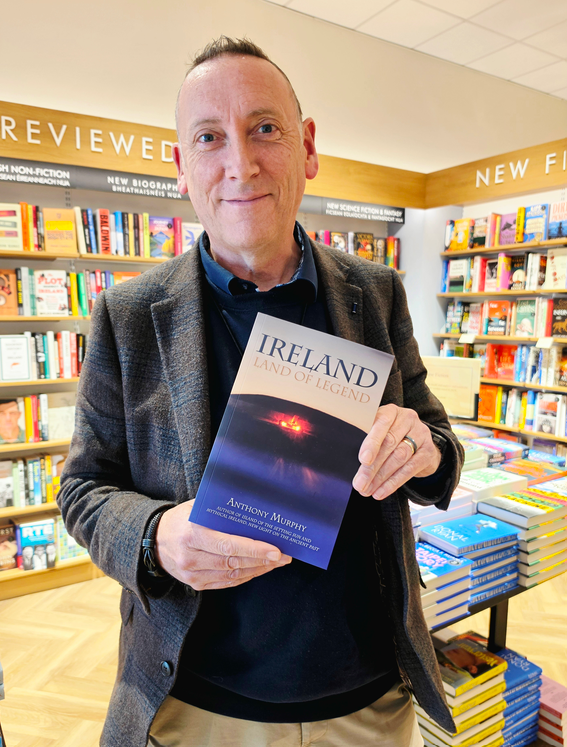
We live in a country where almost every hill, river, lake, mountain and ancient monument has a story attached to it, our ancestors used myth and legend to explain their world, understand the cycles of nature, explore the great mysteries of life and death and express their relationship to the cosmos, local author Anthony Murphy told a book launch in Waterstones.
Murphy has published Ireland: Land of Legend, his latest exploration of Ireland’s mythology and ancient landscape.
He said that when medieval scribes began recording Ireland’s mythology they were writing about monuments and places that were already thousands of years old.
Newgrange, for example, was already more than 3,500 years old when some of the earliest mythological tales were being committed to writing.
The stories were filtered through the worldview of Christian scholars and sometimes overlaid with biblical themes and references. But beneath those layers, Murphy believes, are tantalising glimpses of a much older tradition.

Murphy, who owns the Mythical Ireland website, said he sometimes refers to himself as “an archaeologist of myth”, excavating the layers of stories and looking for fragments of meaning, memory and ancient knowledge that might otherwise remain hidden.
“This book takes us from the great monuments of the Boyne Valley, Tara, Uisneach, Tlachtga and other places in Meath, Westmeath, Louth and it is in these places where we encounter the Dagda, Boinn, Oengus and the extraordinary figures of the Tuatha de Danann,” he said.
Murphy said people might wonder why, after so many centuries, these stories continue to speak to us.
“Mythology is much more than a collection of entertaining stories from a distant past, it was a way of understanding the human condition, it speaks to our hopes and fears, our relationship with nature, our place in the universe and our search for meaning,” he said.
“In a world that seems increasingly troubled, divided and uncertain I believe there is something profoundly valuable in reconnecting with the wisdom of the past.
“One of the ideas I explore is the possibility of a Third Battle of Moytura – not a literal battle between mythological armies but a metaphor for the struggle between darkness and light.
“Ireland’s mythology is not something dead and buried but something vibrantly alive, that continues to evolve and that has much to teach us.”
More than 100 people attended the launch.
Murphy thanked Michael Brennan and Eileen O’Brien of his publishers, Red Stripe Press, along with the many scholars, archaeologists, historians, folklorists, translators and collectors whose work had made his own research possible.
He said there was an enormous debt owed to those who had preserved, translated and interpreted Ireland’s ancient literature and to those who had spent their lives investigating “our extraordinary archaeological heritage”.
He also mentioned archaeologist Patrick McCafferty, whose research inspired one of the chapters in his book, Lethal Legend, along with his close friend, artist Richard Moore, to whom the book is dedicated.
Murphy also thanked the Mythical Ireland community, which has supported his work over 26 years, and most of all his family, wife Ann and children Amy, Luke, Josh, Tara and Finn.
His father Paul, who launched the book, said Anthony had led an extraordinary life so far and wondered where he had found the time and energy to write and publish 11 books.
During that time, Anthony had worked as a full-time journalist, including as a reporter with the Drogheda Independent, editor of the Dundalk Democrat and Drogheda Leader, and with The Farmer’s Journal.
Alongside his journalism and research, he was also a playing member of Drogheda Brass Band with six other members of his family.