
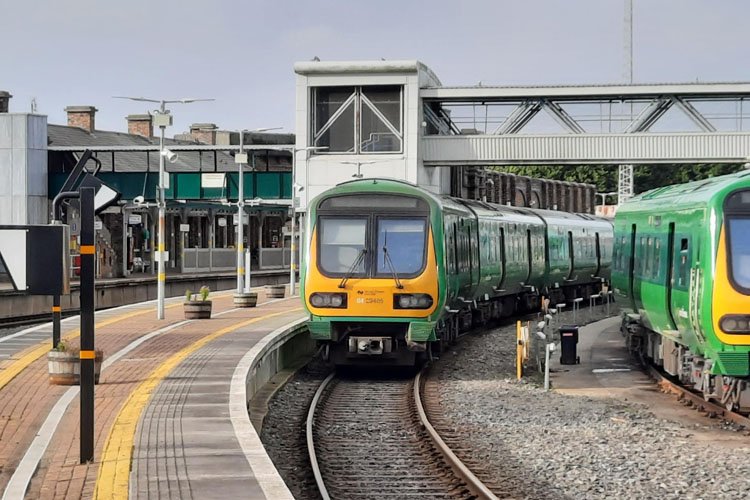
By Simon Gregory
The article A Long Commute and Nowhere to Go was submitted to Drogheda Life by a local commuter who says the piece was inspired by discussion around the planned DART extension to Drogheda.
The writer said the idea came after a local councillor posted photos from a DART photoshoot. When they asked about the lack of toilet facilities in the comments, their comment was removed.
While welcoming the DART expansion, the author said they felt practical issues affecting commuters, such as the lack of toilets on trains and at stations, were not being properly addressed.
A Long Commute and Nowhere to Go

Modern trains, electrified rail and promises of progress are all welcome. But for commuters and day trippers travelling between Drogheda and Dublin, one very basic question remains unanswered.
There has certainly been no lack of enthusiasm from local politicians in relation to the impending DART expansion to Drogheda. Social media feeds are chock-full of updates, press releases, and artfully composed photographs of what is clearly intended to be portrayed as a major step forward for public transport in the area.
We are told about the benefits of electrified rail, clean transport, and lower emissions. We are informed of improved train schedules, increased passenger capacity, and modern trains built to move more people more effectively. The new trains will feature low-floor access, expanded doors, and sliding steps designed to enable many passengers, including those with mobility issues, to board easily without assistance.
There will be increased space for wheelchairs, family zones for pushchair strollers, storage for bicycles, open gangways between cars, USB charging points, CCTV security cameras, and real-time passenger information displays.
On paper, it all sounds exactly like what commuters have been promised for years in terms of modernised transport infrastructure.
Infrastructure announcements also seem to come with no lack of political face time. Photo ops, press releases, and celebratory social media posts are all part and parcel of any major public works project. But while it is certainly good to see politicians eager to be associated with good news and positive developments, it would seem that commuters might also have a right to expect a similar level of attention devoted to figuring out the problems that become apparent once the initial excitement dies down. There is just one small problem.
There are virtually no toilets.
For the tens of thousands of passenger journeys that take place on this line every week, this raises a simple and very practical question.
If you need to use a toilet during your commute, where exactly are you supposed to go?
A commuter line with almost no toilets
There are eleven consecutive stations without toilet facilities on the northern commuter line.
Laytown
Gormanston
Balbriggan
Skerries
Rush & Lusk
Donabate
Malahide
Portmarnock
Clongriffin
Howth Junction & Donaghmede
Dublin Tara Street
This means that if you board a train anywhere along this section of the commuter line, there is a very real chance that neither the train nor the next eleven stations will have a toilet.
That is 11 consecutive commuter stations without toilet facilities on one of the busiest rail corridors in the country.
In reality, between Dundalk and Dublin Pearse there are only four stations with toilets. Dundalk, Drogheda, Connolly and Pearse.
For a rail line that carries such a large number of commuters every day, the lack of even the most basic passenger amenities is difficult to ignore.
The sensible option
Irish Rail has previously suggested that passengers who need to use a toilet could simply get off the train at a station and use the facilities there.
In theory that might sound reasonable.
In reality, most stations along this commuter corridor are unmanned and do not have toilet facilities.
Even in the unlikely situation where a passenger happens to be approaching one of the very few stations that does have a toilet, the solution still raises practical issues. Leaving the train to use a facility would mean allowing that service to depart and waiting for the next train.
For many commuters that is not a minor inconvenience. It could mean arriving late for work, missing a medical appointment, or disrupting an already tightly scheduled day.
Which brings the question back to the same point.
If the train has no toilets and the station has no toilets, what is the passenger supposed to do?
The new DART trains
The new DART+ trains currently being tested appear to be designed with one main purpose in mind. Increasing the number of passengers that can be carried.
- Increasing standing room
- Increasing passenger capacity
- Increasing the width of the doors for faster passenger flow.
- Providing areas for wheelchairs, pushchairs, and bicycles.
- Each train will be able to carry well over a thousand passengers.
What this means for commuters is:
- Fewer Seats
- Fewer Tables
- More standing room
For commuters who use the train to work, read or simply travel comfortably, it represents a noticeable shift in priorities. Additional bike storage is often highlighted as a feature of the new trains. However, bicycles are generally not permitted on commuter services during peak travel times, when trains are busiest. For many daily passengers travelling to and from work, this means those bike storage areas may see limited use during the times when trains are most crowded.
Accessibility but also functionality
One of the key public focuses for the new fleet is accessibility.
Low-floor boarding, sliding steps, and larger doorways are all touted as methods of enabling many passengers, including those with mobility impairments, to board trains independently.
This is a good thing. However, accessibility must also include the ability to complete a journey with a degree of basic dignity and comfort.
For senior passengers, pregnant passengers, parents with infants, or anyone with medical issues, access to toilet facilities during a journey is not a luxury. It is a necessity.
A predictable problem
This problem also brings to mind another problem that regular rail commuters are all too aware of. Later evening services on commuter lines often find themselves plagued by anti-social behavior, particularly when trains are packed, and stations are largely unstaffed.
Without basic facilities available on either the train or the stations, it is not hard to imagine a scenario in which passengers, through desperation, intoxication, or anti-social behavior, might choose to misuse the train itself as a facility.
No one wants to see this happen, but it is a predictable consequence of transporting large numbers of people long distances without access to basic facilities. Preventing problems like this is far easier than dealing with them after they arise.
The politics of progress
Infrastructure projects are often political triumphs long before they are even completed. The DART expansion is no different.
Many of the local representatives are now actively promoting the project as a sign of progress and investment in the area. Social media updates are highlighting accessibility improvements, capacity increases, and connectivity improvements, often with photos to celebrate the development.
However, when commuters bring up practical concerns about passenger facilities, it seems like these conversations are much less visible.
It sometimes seems that more time is spent dealing with negative comments on social media than is spent dealing with the actual issue that is being raised. If a fraction of the time spent dealing with negative comments on social media were spent addressing the Irish Rail or National Transport Authority about something as simple as toilet facilities, perhaps the comments wouldn’t need to be made in the first place.
After all, commuters are not raising these concerns to be negative. They are raising them because they are the ones using the service every day. Practical problems don’t go away when they’re ignored. They ensure that commuters continue to bring them up.
A commuter system that is efficient
Taken together, the direction of this project indicates a philosophy for the future of rail transport as follows:
- More passenger density
- Faster boarding and alighting times
- Fewer staffed stations.
- More operational efficiency
In short, a network designed to move large numbers of people as quickly as possible.
But commuters are not cargo.
They are people traveling long distances every day for work, education, and family.
And sometimes people need to use a toilet.
A very simple question
The DART extension to Drogheda is often hailed as a big step forward for transport in the area. More trains, more capacity, and better access are all to be welcomed. But progress should not mean forgetting the basics.
For commuters traveling on this route every day, the problem is not complicated, political, or ideological. It is simply practical.