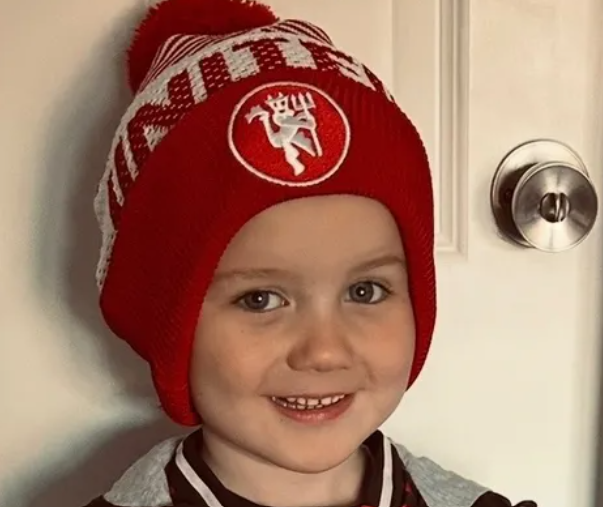
A Drogheda family has shared the story of their five-year-old son Theodore to raise awareness of childhood cancer and support the charities that have helped them since his diagnosis.
Theodore was diagnosed with T-Cell Acute Lymphoblastic Leukemia, an aggressive childhood cancer, after becoming unwell in late 2025.
Until then, his family describe him as a healthy and active five-year-old who had never needed to visit a GP. He was just four months into primary school, attended Drogheda United every Friday night and went to football academy each Saturday morning.
On 4th December 2025, Theodore was brought to A&E after his parents became concerned about sporadic vomiting, lethargy and a loss of appetite. They were told his illness was viral and he was given anti-sickness medication before returning home.
His symptoms subsided, but two to three weeks later he developed a bark-like cough and laboured breathing. After seeing a GP, he was diagnosed with croup and prescribed steroids along with inhalers.

Several weeks later, the vomiting and lethargy returned. While dressing Theodore, his mother noticed a mass close to his collarbone measuring around 5cm.
He was brought back to A&E, where his family requested blood tests.
Following the results, Theodore underwent a CT scan. His family said the scan revealed an 11cm posterior tumour extending towards his right lung, 2mm nodes on the lower lobe of his left lung, as well as enlarged kidneys and spleen. They were also told leukemia blasts were present in his spine and brain.
Theodore was transferred by ambulance to Crumlin Children’s Hospital and admitted to the Paediatric Intensive Care Unit due to respiratory distress.
His family said the following 48 hours were critical.
Theodore subsequently left PICU and was admitted to John’s Ward in Crumlin Children’s Hospital, where he remains under the care of his medical team.
His treatment is expected to span between two and three years and includes multi-agent chemotherapy, repeated lumbar punctures and intrathecal chemotherapy, with the first nine months described by his family as the most intensive stage.
Theodore now has a central venous line, which he calls “Freddie”, running from a vein in his neck into his chest. It has two ports, one for chemotherapy and another for blood draws.
He also has an NG tube running from his nose to his stomach, which allows his mother to administer chemotherapy at home after receiving training.
His family said he remains largely isolated because even a small infection can result in hospital admission.
Despite everything he is going through, they say Theodore continues to smile and thank the nurses and doctors caring for him.
His parents said one of the hardest parts of childhood cancer is knowing that, as a parent, there are moments when they cannot protect their child from the treatment he has to endure.
They now want Theodore’s story to encourage other parents to trust their instincts when they feel something is not right and to keep seeking answers.
The family has also set up Theodore’s page to raise awareness of childhood cancer and to give back to the charities that supported them during the first difficult weeks following his diagnosis.
They said a number of organisations, including smaller charities, offered guidance and practical support at a time when their lives had changed completely.
Aura Leisure Centre has also approached the family to support their efforts to raise awareness and funds.
The family said they hope that by sharing Theodore’s story, they can help shine a light on childhood cancer while supporting other children and families facing a similar diagnosis.
Please donate if you can https://gofund.me/13a255687