
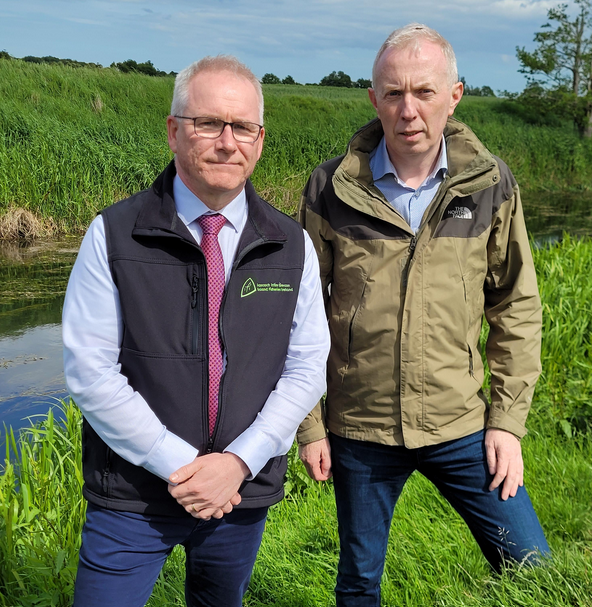
Photo: IFI CEO Dr Eamonn Kelly and Minister Timmy Dooley TD at the River Glyde
Minister of State at the Department of Climate, Energy and the Environment Timmy Dooley and CEO of Inland Fisheries Ireland (IFI) Dr Eamonn Kelly visited the site of the fish kill on the River Glyde in County Louth yesterday.
IFI estimates that more than 20,000 fish have died in the incident over an approximate 25km stretch of the river in counties Louth and Monaghan.
IFI is continuing to investigate the incident. The prompt investigation is following a definite line of enquiry. The source of the pollution has been identified as an agricultural discharge, which has been stopped. A file is now being prepared for potential prosecution.
Fish mortalities include Atlantic salmon, eel, brown trout, pike, minnow and coarse fish species.
Water samples taken at the river have been sent for laboratory analysis.
Separately, Louth County Council has been monitoring oxygen levels in the river in County Louth and is satisfied that the incident is clearing, with levels returning to normal.
Louth County Council has liaised with Uisce Éireann.
Commenting, Minister Dooley said:
“I, and Government colleagues, recognise the enormous impact that fish-kills can have on the local community and users of the catchments, particularly where the fish-kill is as significant as I have seen first-hand here today on the River Glyde. The scale of what has happened here is very concerning. I want to assure local communities that this incident is being treated with the utmost seriousness. Inland Fisheries Ireland is leading a thorough investigation, and I want to thank them and other agencies involved for their swift action. I also want to thank the local community and those who reported concerns or assisted in the response effort.
“We last saw an incident of this scale last August on the River Blackwater in County Cork. At that time, I established an inter-agency group to collaborate on that investigation. The inter-agency group was coordinated by Inland Fisheries Ireland and drew in expertise from many State bodies and agencies.
“We subsequently asked the EU Joint Research Centre (JRC) to carry out an independent, science-based review to consider the actions taken during the Blackwater incident. The JRC’s report published in February of this year confirmed that the agencies had responded quickly, and that an extensive investigation had been carried out. The report also identified areas where systems could be strengthened.
“Many of those recommendations are now being progressed in the short term, including those aimed at strengthening how State agencies work together. An Inter-Agency Protocol Group was established by IFI to coordinate this work also involving the EPA, Marine Institute and local authorities and has been finalised. The protocol is currently going through a final approval process within each of the respective organisations, prior to an anticipated launch later this month.
“Today, however, my immediate focus is on the incident that has happened here on the River Glyde. It serves as a reminder of the importance of protecting our rivers and waterways every landowner, business, and individual has a responsibility to ensure that their activities do not negatively impact water quality. I would encourage anyone who observes pollution or fish distress to report it immediately to Inland Fisheries Ireland.”
IFI CEO Dr Eamonn Kelly said:
“This was a devastating fish kill event.
“We really appreciated the early report from a member of the public, who alerted us to this incident and allowed our IFI team to respond rapidly.
“IFI teams will continue to work on the river throughout the weekend and into next week to assess and monitor the impact. We will consider what further efforts are required at the River Glyde to rehabilitate the habitat for fish populations.
“Inland Fisheries Ireland continues to urge the public to report issues of concern to its confidential 24/7 number, 0818-347424.”