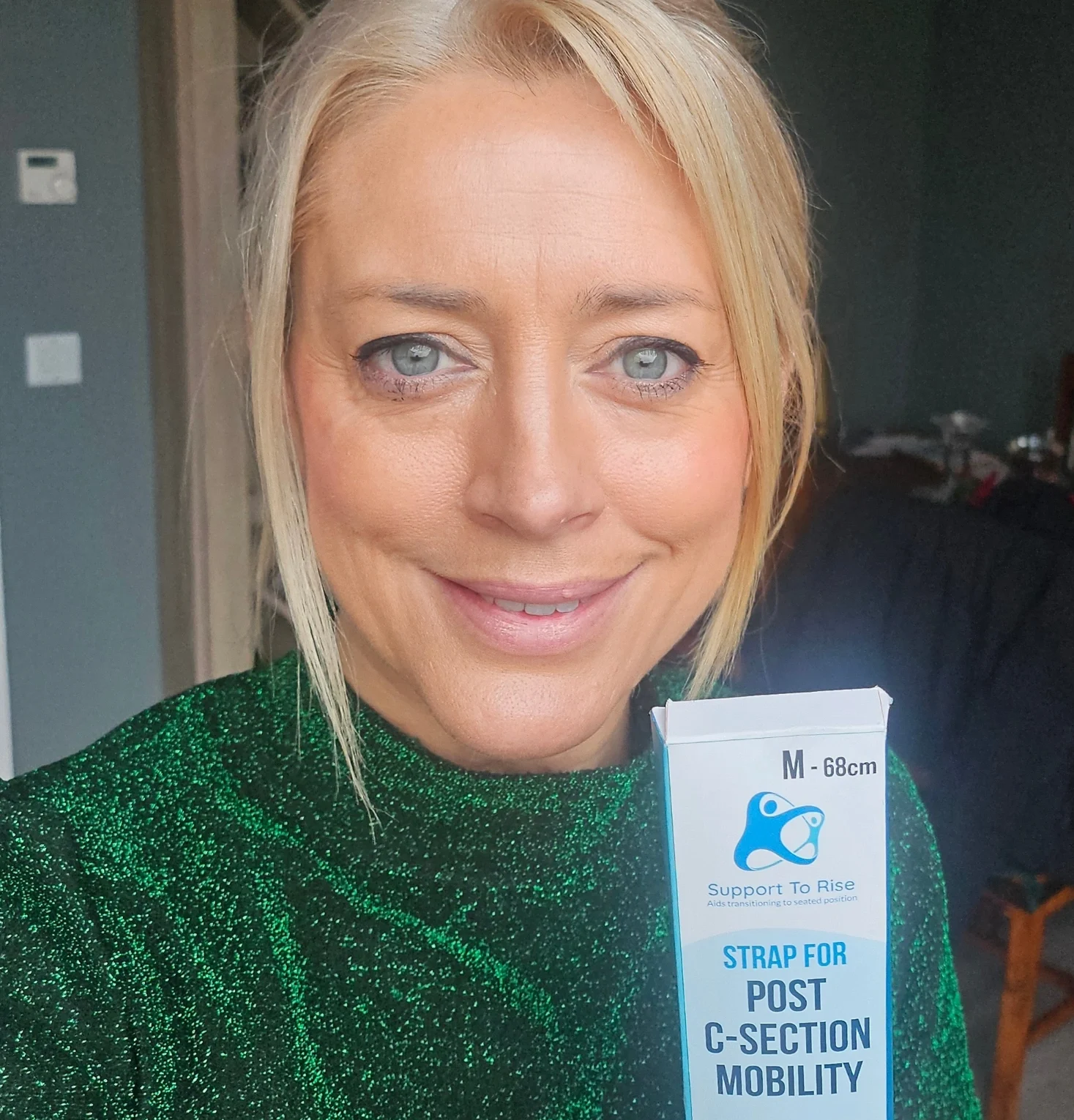
Support to Rise began not as a business plan, but as a response to a moment many women quietly struggle through. Hazel Rossiter, a Drogheda woman and mum, developed the Support to Rise strap after experiencing an emergency C-section with her youngest child. “The Support to Rise strap for post C-section mobility helps women rise up out of their bed with less pressure put on their abdomen,” Hazel explains.
After surgery, she found the lack of practical support especially difficult, particularly during the night. “The staff in the hospital are incredibly busy and not able to come to help you out of bed. Having support available for this was a must.”
That experience stayed with her. She knew first-hand how vulnerable those early hours and days after surgery can be, and how important mobility is once a catheter is removed. From that point on, the idea for Support to Rise began to take shape.
Turning a problem into a practical solution
Hazel designed the strap with simplicity and safety in mind. It is used when a woman is lying back in her hospital bed, propped up by pillows rather than lying flat. The strap is placed just above the knee on the side the woman is exiting the bed.“You place your fingers through the handle and use the strength in your arm to pull yourself up into an upright seated position instead of engaging your core abdominal muscles,” she explains.
The goal is independence, reducing strain and allowing women to move safely at a time when even small movements can feel overwhelming. Developing a physical product was no small task. Hazel knew exactly what she wanted the strap to look like and had drawings made, which were then turned into a prototype. After several tweaks, she was happy with the final design.

She applied for patent protection in Ireland, which was granted, and later applied for a European patent, which is still pending. She then took the product to maternity hospitals to gather professional feedback. “It was only then that I thought this could go further,” she says. “When I received the endorsement from the HSE, it was full steam ahead.”
Rooted in Drogheda, built for mums everywhere
Keeping Support to Rise rooted locally was important to Hazel. “I had my babies in the Lourdes Hospital as I am a Drogheda gal,” she says. “I would love all local girls who have a C-section to be able to buy this strap as quickly as possible.”
That is why Support to Rise is stocked in Crosslanes Pharmacy beside Our Lady of Lourdes Hospital, making it easily accessible for new mums. The strap is also available online, with local delivery. Feedback from mums has been overwhelmingly positive. Many describe the strap as a game changer in their post C-section recovery.
Hazel also participated in a clinical evaluation study with the Health Innovation Hub of Ireland, where physiotherapists, occupational therapists and midwives tested the product. “The professional feedback was all very positive, which I am thrilled about,” she says.
She believes postnatal recovery, especially after a C-section, needs to be talked about more openly. “The C-section rate is nearly one in two births,” she explains. “I remember thinking I was never having one, and then afterwards it hit me like a ton of bricks. I had no clue about the spinal injection, the catheter, or how long recovery would really take.”
Looking ahead with patience and purpose
Seeing Support to Rise move from an idea into a product sold locally and online has been deeply rewarding. “It is a very proud feeling to have developed something mums can use at such a vulnerable stage of their lives,” Hazel says. “Every mum deserves the best support at this crucial time.”
The biggest learning curve so far has been patience. Working with large systems like the HSE and NHS has been challenging. “Nothing moves quickly and the budget is not always there,” she explains. “But I have met some incredible healthcare professionals who genuinely want to provide the best support possible.”
While Hazel still works full-time and juggles the business in evenings and weekends, local support has been encouraging. Support to Rise was designed for post C-section recovery but can also be used following other abdominal surgeries, including hysterectomy and bowel surgery. Looking ahead, Hazel plans to focus more on direct sales to customers. After extensive professional feedback, she is confident in the product and its value.
Her message to new mums recovering from a C-section is simple and reassuring. “There is support available. Support to Rise can be your first step in helping you out of bed and giving you that independence you deserve. Take it easy, do not try to do too much, and know that it will get easier in time.”