It’s the Pump Prices, Not Outside Influence
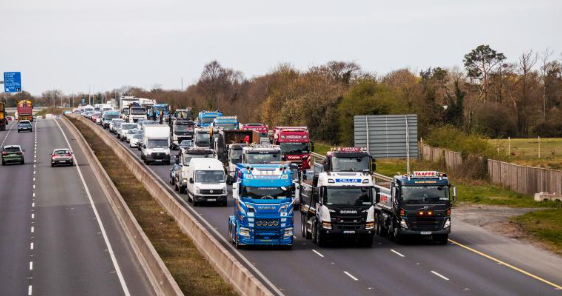
OVER 50% of the price of a litre of diesel and petrol is tax and excise duty, yet a government minister tried to blame the fuel protests and blockades on Tommy Robinson. If you wanted to know just how out of touch ministers are with what is going on in the country, it was there in abundance in the government’s reaction to the protests.
Justice Minister Jim O’Callaghan claimed that fuel protesters were being influenced by external figures, urging them to recognise the impact of their actions. The protestors have been calling on the government to do likewise, and hopefully, ministers have now got the message, but as of today, it’s still not clear if there will be a meeting with the leaders of the protests.
Minister O’Callaghan might also have added that it’s not Tommy Robinson but his government that accounts for 59% of the price of a litre of petrol and 52% of a litre of diesel. I’m sure that the only figures influencing those taking part in the protests are the ones which keep rising at the forecourt pumps.
The conflict in Iran has sent the price of diesel souring raising fears that some hauliers and farm contractors will be out of business, and this has led to the widespread protests. What is certain is that all goods transported by road, and that’s everything on supermarket shelves, will go up in price during what is one of the worst cost of living crises in years.
In essence, the Government is partly responsible for driving up prices and inflation by refusing to cap the price of fuel. Agricultural produce will be worse hit, as along with the increasing price of diesel for farm machinery, and an acute shortage of fertilizer, as most of it comes through the now closed Straits of Hormuz.
While the blockade of ports and other vital infrastructure are illegal and should be removed, the Government also has a responsibility to take measures to alleviate the growing crisis. It should never have been allowed to come to this, and if the Government had been more flexible and in touch with what is happening in the country it wouldn’t.
A cap on the price of diesel and petrol, as deployed in other EU states, would have gone a long way to help the haulage industry and ordinary people who have to commute to work. Instead, the Taoiseach and his ministers have been implying there is something “sinister” at play rather than people who are angry and frustrated fearing they will lose their livelihoods.
Tanaiste Simon Harris went on to say that “this is not a lawless country” and that the “laws of the land will and must be applied without fear”.
This is only partially true, as there are thousands of people who have been allowed into this country without documentation and thousands more who are still in the country after being served with deportation orders.
In both cases, laws have been broken, but it would appear that the Government is not applying the law when those breaking it are not from this country. Minister O’Callaghan urged the protesters to funnel their anger on the cost of fuel through their representatives in Dáil Eireann, which was somewhat ironic seeing that the Dail is still on a 19-day Easter holiday as the country grinds to a standstill.
It is never a good look when a country has to call on its military to deal with civil unrest, especially when a meeting with those protesting may have been enough to resolve the situation. The prospect of the Army confronting school bus drivers, farmers and hauliers might be interpreted as the Government escalating rather than resolving it by simply opening dialogue with the protestors.
Essential Works, Appalling Finish
THERE’S a lot of work going on around the town with many pavements dug up and temporarily filled in with tarmac, and in Yellowbatter, a once green area was left like a mud pit by Uisce Éireann. As a former resident of the area, I couldn’t believe the state it was left in while the pavements in the Hand Street area have been left so uneven, they are likely to cause an accident and would be almost impossible to navigate with a pram or buggy.
While this essential work needs to be carried out, it is not good enough that areas where they have taken place are left in such an appalling state.
Local Senator Alison Comyn is taking up the issue with Uisce Éireann and hopefully they will act quickly to undo the damage.
A Pint with the Groceries? Not in Drogheda
I SEE Lidl is opening its first pub on the other side of the border, but it’s unlikely that you’ll be able to pop in for a quick pint while doing the shopping at their two Drogheda stores any time soon.
The development came about because of Northern Ireland’s strict licensing laws, which meant the German supermarket giant was unable to get a standard off-sales licence for its shop in Dundonald in east Belfast. To get around this Lidl is building a pub, as its licence comes with the legal right to operate an off-sales section.
Speaking of licences, drivers might be in danger of losing theirs if they pop in for a few pints while doing the shopping.
Nuclear Plans Meet Irish Reality
THE Journal has reported that a motion in favour of nuclear energy is due to go before the Fianna Fáil Ard Fheis next month. When the Government can’t finish the most expensive hospital in the history of mankind you can only imagine the chaos and delays that would be involved in construction of the country’s first nuclear reactor.
A decade ago, then Health Minister Leo Varadkar said “short of an asteroid hitting the planet” the €700 million facility would be built by 2020. It’s now 2026, the cost is at least €2.3billion and rising, and the hospital may not be ready for another year. That’s why if they tried to construct a reactor it would probably cause more damage than an actual asteroid strike and probably be located in Drogheda.