
By Sean Collins
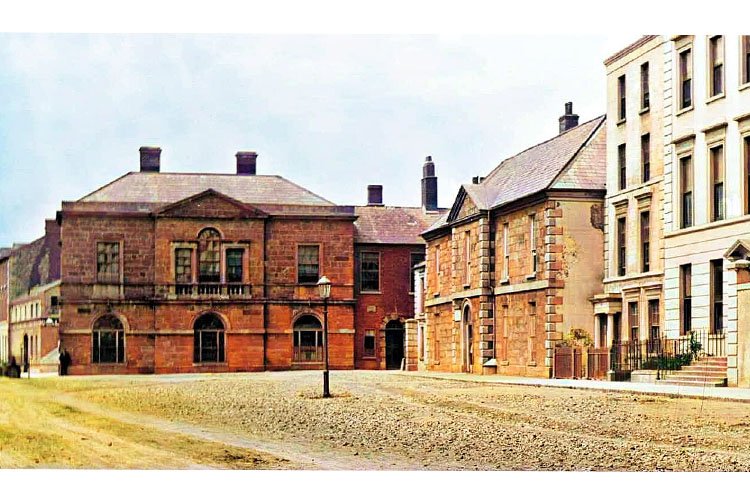
It was once one of Drogheda’s most impressive buildings and very much part of the town’s history, but today the Mayoralty House, an important part of the town’s heritage on The Mall beside the River Boyne, is part of a neglected and very sad vista.
For many years from the mid seventies it was the busy premises of the Sound Shop, now the ground floor is a food market and much of the building lies vacant and uncared for. Can we dare to hope that someday this fine building, an important part of the town’s heritage, will be returned to its former glory?

It was built in 1768 as a banqueting house for the Mayor, it was never a residence. The Drogheda Orange Lodge held their monthly meetings there in in the early 1800s but by 1836 the Orange Order was in decline in Drogheda and Catholic Emancipation was just around the corner.
In 1843 Daniel O’Connell, the “Liberator” arrived at the Mayoralty House having paraded through the main streets of the town and addressed the townspeople from a platform on the Mall in support of ‘Repeal’.
There were similar scenes in 1884 when Charles Stewart Parnell addressed the assembled townspeople from the great side window of the Mayoralty House after he was awarded the Freedom of the Town of Drogheda.
Addressing a recruitment meeting in the Mayoralty House in January 1915, the former MP, poet and university lecturer Tom Kettle, said: “I will be fighting for Ireland.” Sadly, he was dead within a year, another victim of the savagery of the Great War.
George Henry Bassett’s description of the Mayoralty House in 1886 in his Louth Directory is among the best;
“One of the most interesting buildings of Drogheda is the Mayoralty House. The face is of cut limestone and the height two storeys. It fronts on Mayoralty Street and at the south end adjoins the Quay.

“The entrance hall gives an idea of baronial magnificence, lofty ceiling and broad stairs. To the right is the door opening on the kitchen, a place of solid furnishings and frequent suggestions of tremendous roasts. On the left of the hall is the Mayoralty reading and billiard rooms.
“The rooms on the second floor are used severally by the Mayor and High Sheriff. Both are furnished after the manner of banqueting halls of the last century. The Mayor’s room is the larger and the more imposing. There are two large brass grates set high to throw the heat toward the head rather than the lower part of the body. Above each are views in oil of Drogheda, showing the town when its walls and towers were standing.
“The ceiling is about twenty feet high, and the immense windows looking upon the street and the river, have heavy crimson rep curtains. The length of the room is eighty feet and width thirty.

The Mall as it used to be showing the Mayoralty House and the Whitworth monument. The exact date of the photo is unknown but it was taken for the Lawrence collection by Robert French who died in 1917.
“Over the entrance door there is a gallery for an instrumental band. It is supported by four engaged columns and so arranged to encroach very little upon the room. According to the records of the Corporation, examined carefully by Mr. John J.F. Greene A.B.,C.E.,T.C.D. Borough Surveyor, to whom I am very much indebted, especially in the matter of dates, the lease of the ground on which the Mayoralty House stands was signed on the 8th April, 1765.
“The various minutes on this subject show that the building was ordered to be finished on the 8th July 1760, and that on the 22nd April 1768, it was ordered to be fitted for the reception of the Mayor and Corporation for quarterly dinners.
“During the Mayoralty of Ald. Patrick Casey Connolly the Mayoralty house has been redecorated and has been used by him for banquets to the members of the Corporation and distinguished visitors. Alderman P.C. Connolly was the first Nationalist Mayor elected in Drogheda”.

The Mayoralty House, having fallen into disuse as a municipal building, became a dancehall, a clothing factory, and was sold to the Sound Shop in 1976. It was sold on in 2006.
Summing up a detailed description of the Mayoralty house The Architectural Archive says; “This fine limestone building stands testament to the former prosperity of dockside trade in Drogheda.
“This building with its varied window openings and treatments, including the grand and striking Venetian window, is a handsome and robust building, built in the Classical Idiom with central pedimented breakfront makes a positive addition to the streetscape.
“Much of Drogheda’s rise as an urban centre was based on its strategic location on the River Boyne, over the centuries merchant activity has been focused on the quayside, physical remains of this history makes this structure an important addition to Drogheda’s architectural heritage.
One thought on “Drogheda’s historic Mayoralty House looking sad and neglected”