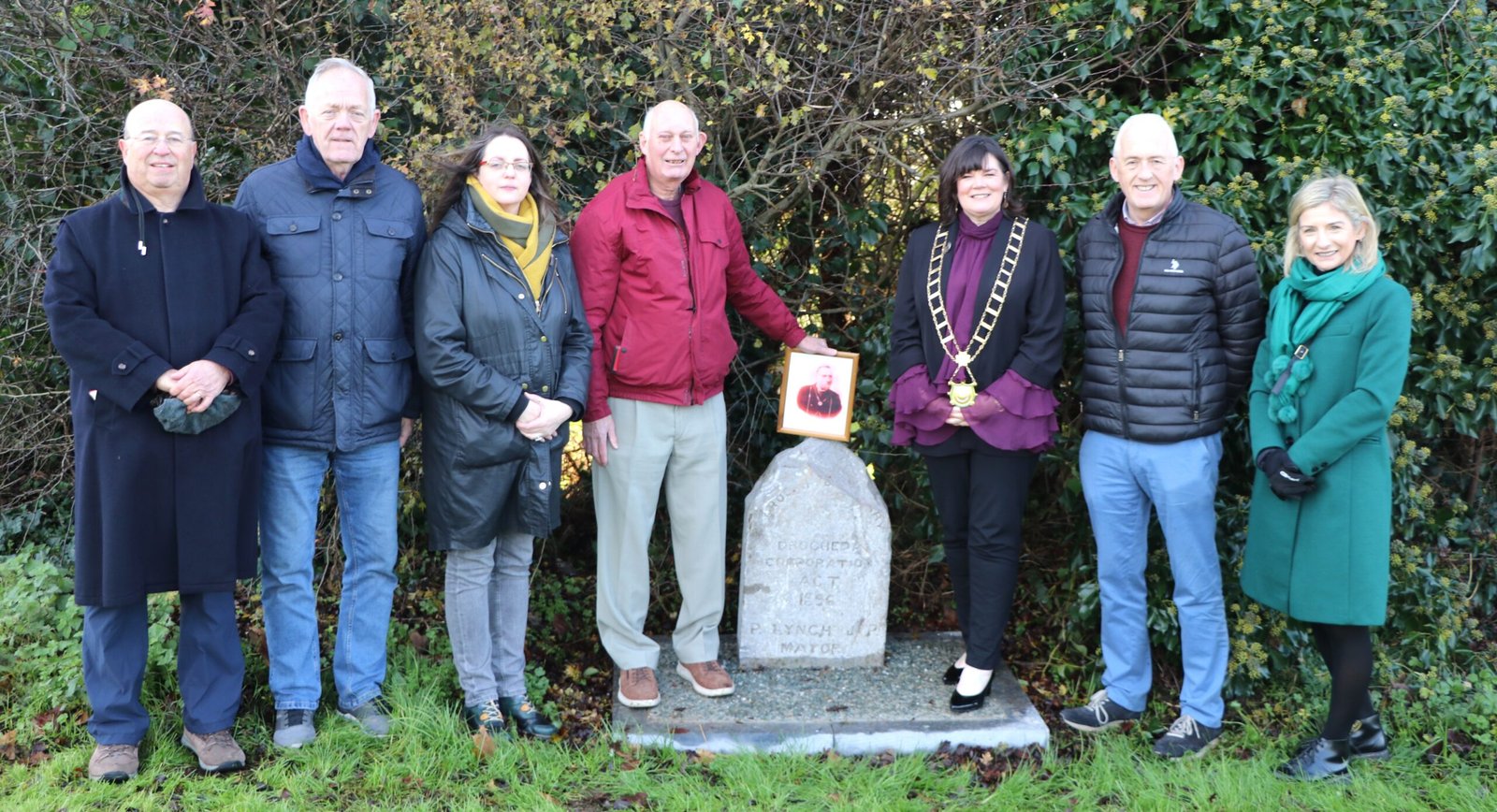
Drogheda Tidy Towns has completed the restoration of the town’s historic Borough Boundary Stones, marking the end of a major heritage project that celebrates an important part of Drogheda’s municipal past.
The stones date back to 1896, when the Drogheda Corporation Act expanded the town’s borough boundary to include Mell, Ballsgrove, Beamore, Bryanstown, Newtown, Rathmullen and Newfoundwell. Thirteen stones were originally installed to mark the perimeter of the newly enlarged borough. Nine of those stones are known to survive today.
At the time they were placed, the River Boyne still divided Drogheda between County Louth and County Meath. Just two years later, the Local Government Act of 1898 moved the southern side of the town into an expanded County Louth. The 1896 boundary extension paved the way for that change.
The original stones were set in place by Mayor Peter Lynch. Their locations were rediscovered by Alan Lynch, a descendant of the former Mayor, whose family still hold strong ties to the town. Each stone stands about 43 inches high, features a pointed carved top and is inscribed with the details of the 1896 Act.
In 2024, Drogheda Tidy Towns began a careful conservation programme to restore and secure the stones. The project was funded by The Heritage Council of Ireland. The stones have been cleaned, straightened and reinstated using best-practice conservation methods, with archaeological guidance throughout. An application has been made to add them to the Protected Structures Register.
A QR code will be placed at the base of each stone in the coming months, allowing visitors to access historical information online.
Speaking at the completion event on Thursday, December 4th, Mayor Michelle Hall said the project shows what can be achieved when community groups, heritage bodies and local authorities work together.
“This restoration protects an important part of Drogheda’s history and ensures future generations can learn from it. I commend Drogheda Tidy Towns and all involved for their dedication and work.”
Drogheda Tidy Towns thanked The Heritage Council for funding, Deirdre Murphy and ACSU for archaeological support, Gerry White and Glas Civil Engineering for their workmanship, and Community Finance Ireland for bridging finance. The group also acknowledged the ongoing support of Louth County Council and paid special tribute to Alan Lynch for the research that provided the foundation for the project.
Chair of Drogheda Tidy Towns, Gerry Leydon, said the team is proud to see the stones restored and protected.
“This project reflects the importance of preserving Drogheda’s heritage. We are very grateful to everyone who made it possible.”