

Meath is a deeply historical County, due to its proximity to England and its notably arable soil
and agreeable topography. Trim in particular is rich in Irish heritage. Excavations carried out
in the area revealed there may have been settlers in the area as 370 BC. The town was
officially established in the 5 th century AD. The drive from Drogheda to Trim takes
approximately 40 minutes.
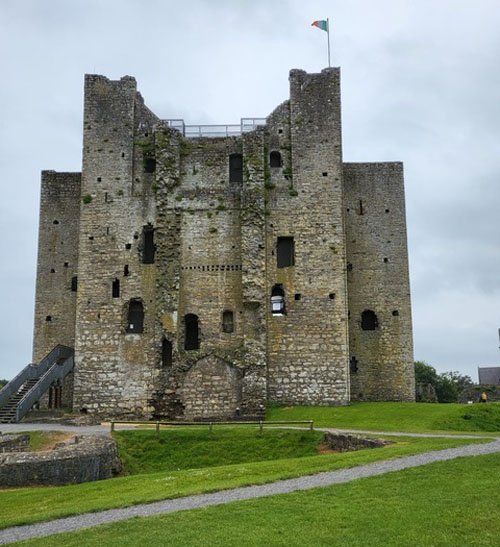
- Trim Castle Approximately 160 Anglo-Norman castles can be identified in
Ireland today, but Trim Castle is by far the most well-preserved of them all, as well as
being the largest. Its construction dates back to 1172, built by Hugh De Lacy who
had been given the Kingdom of Meath by King Henry II. It is a majestic and towering
structure situated in the west of the town. - Dangan Castle Dangan Castle is located on the Trim Road, just outside
Summerhill. Although now in ruins, the building has been a host to
considerable history and tells a rich story of social and political dynamics in
Ireland. The 1 st Duke of Wellington (who had beaten Napoleon at The Battle of
Waterloo) lived here as a child with the rest of the Wellesley family. The ruin is a
quaint and melancholic site, one in which centuries of history are told. - The Tomb of The Jealous Man and Woman Situated at St Peter
and Paul’s Cathedral in Newtown, Trim, this tomb dates back to 1592. Sir Lucas
Dillon and Lady Jane Bathe are buried here. Sir Lucas Dillon was Attorney General
and Chief Baron of the Irish Exchequer. In Lusk, Sir Dillon’s 2nd wife was buried with
her husband in an identical tomb, so this tomb in Newtown is supposed to be a
jealous gesture in response. Although the tomb is spotted with mould and chipped
away over the years, there are real emotions held static in time by this structure. - The Yellow Steeple The Yellow Steeple was a Belltower, built as a part
of St. Mary’s Abbey after the original abbey had been burned down in the 1360s. 300
years later, Cromwellian forces had damaged the Steeple in the 1640s, by cannon
balls sent flying across the River Boyne. The Steeple is situated in the historic
medieval Porchfield’s, along the river. It is best to see this unique landmark in the
summer, as the steeple reflects a yellow light on sunny days, hence its name. - Priory of St. John the Baptist Founded by Simon De Rochfort in 1202,
this priory was home to an order named the ‘Crutched Friars’ as they carried staffs
with crosses atop of them. The friars residing at this priory were of the Augustinian
Order, and they ran a hospital here. The friary disbanded in 1540, and the building
was then used as private housing. Among familiar green flat fields this uniquely
shaped ruin is illuminated, and is perfect for a quiet and ruminative visit.
Visiting even one of these sites is a surefire enjoyable and atmospheric way to improve upon your historical knowledge. Meath being the Royal County provides its historical landmarks with a great sense of importance. Trim appears modest, but lets its historical features speak for themselves in their stature and significance. So choose whatever interests you from this list and enjoy some low-cost leisurely education!