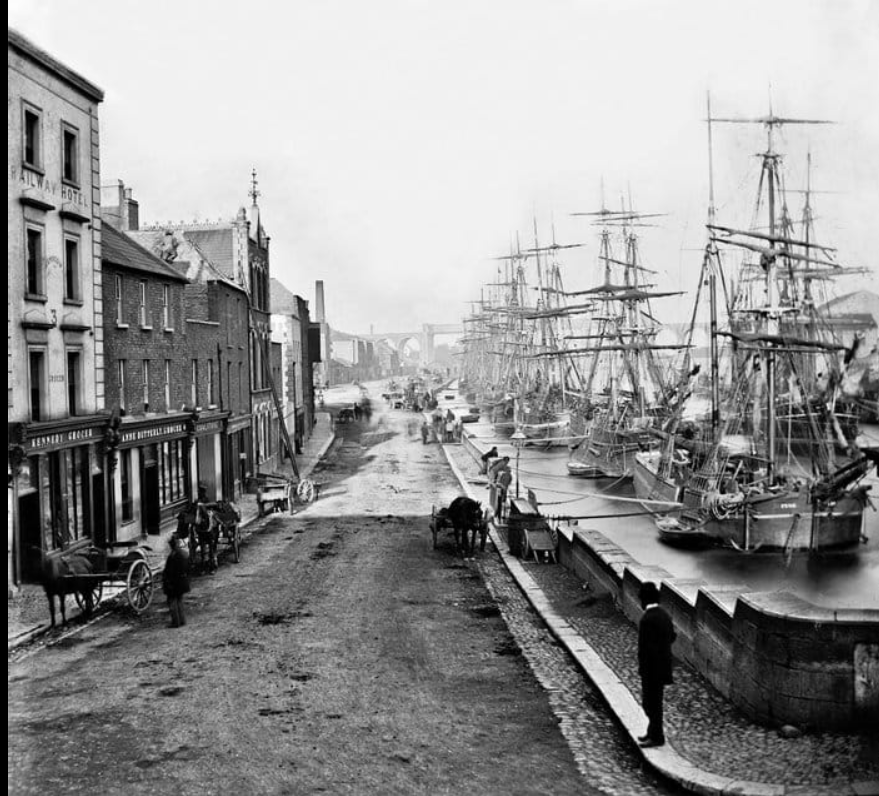
Drogheda was once among the most important ports in the country and one of Liverpool’s oldest trading partners. Who knew? Who cares? Actually I’d go as far as saying that a good many people in our city are totally unaware that Drogheda remains a thriving port with a great maritime history. Gone is the old customs house that once stood where the Intreo is now on Custom House Quay. At least they kept the name because we’re great ones for obliterating entire streets from our collective memories.
Further down the quays the entire row of houses, a street, where Georgie’s pub once stood and the old Drogheda Steam Packet Company offices were located were raised to make way for a warehouse. Where is the old Steam Packet Company water tower dating from the 1830s gone?
On the Boyne Road the old Harbour Board yard with its ancient gates met a similar fate in the late 1970s to make way for another warehouse that is now unused and up for sale. Ironically that same yard held the remains of the old Whitworth Monument that was ripped from The Mall to make way for a weighbridge. That’s the kind of respect Drogheda has for its history and its benefactors. But it’s not too late to save some of our heritage, surely with some many derelict buildings around the area, space could be found for a maritime museum.
Unfortunately when it comes to underselling itself, the port, like many other aspects of the borough, is a world leader. Much of the physical evidence of the port’s illustrious past has been destroyed over the years and there is little to show that Drogheda was founded around the Boyne and its access to the sea.
On its coat of arms below the star and crescent is a sailing ship over the latin inscription which translated reads: “God our Strength, Merchandise our Glory.
I’ve just finished a book “The Hurricane Port: A social history of Liverpool” by Andfew Lees which makes several references. It does not state that the town is in Ireland so it can be assumed the port was of such importance to that great city its location would be known to most Liverpudlians.

And why wouldn’t it be when there was a passenger service running three times a week between Drogheda and Liverpool right up until the 1920s. It was the Ryanair of its day when you could board a ferry from the North Quay and be looking up at the Liver Building eight hours later. There was a time when ships were docked up as far as St Mary’s Bridge on both sides of the river but in more recent years the main business of the port has been conducted down the quays to the east.
At one time it was possible to walk down the quays, but the entire docks area is now off limits to the public for security reasons. A maritime museum would be a great way of remembering Drogheda’s seafaring past before what’s left of it is gone forever.
Faith Without Borders in a Canary Islands Church
I’ve been in Fuerteventura for the past week and it looks like the bad weather followed me over as it’s been raining on and off ever since. When I went to mass in the local church in Corralejo, Nuestra Señora del Carmen (Our Lady of Carmen) I was amazed to find that they share the building with the sizable Anglican community in the town.
Although it’s a Catholic church Anglican masses also take place there which is a great example of interdenominational harmony. I’m sure Fr Iggy O’Donovan would agree that this is an “ecumenical” matter even though the Church hierarchy didn’t think so when he extended the hand of friendship to fellow Church of Ireland Christians some years ago.
The World’s Dearest Drink, and It’s About to Get Dearer
More taxes are needed on alcohol claims the World Health Organisation – have these guys never been to Ireland, a country with the most expensive drink in Europe. Here in Fuerteventura a bottle of beer can be had in a pub for €2.50 while a pint will set you back no more than €3.50. If you look around you can get a pint for as little as €1.50 during happy hour.
Guinness brewer Diageo confirmed this week that the price of a pint of Guinness for sale to pubs will rise by seven cents and a pint of Guinness 0.0 will go up by 10 cent from next month. Isn’t it ironic that the least harmful drink – a pint of stout – is rapidly becoming unaffordable for ordinary working people while a bottle of whiskey can be bought in a supermarket for as little as €22.30.
The Vintners’ Federation of Ireland (VFI) has rightly criticised Diageo’s decision warning that the move will pile yet more pressure on pubs already struggling to survive. It will also encourage some people to buy in bulk in supermarkets and drink at home instead of going to the pub where their consumption of alcohol would be better retulated…if nothing else by the price.
Trying to Pay a Bill in Ireland: A Modern-Day Puzzle
I switched my mobile phone provider recently from Vodafone to Tesco and saved myself €16 a month for what is roughly the same service.
The only problem is I still owe Vodafone €35.69 but cannot figure out a way of paying the bill. The Vodafone shop in West Street will not accept payment and now that I’m no longer a customer I can’t pay the bill online as the system won’t allow me to log in. Any ideas?
From the Big Snow of ’82 to Climate Fear in 2026
Last week I was reminded of the “Big Snow” of 1982 when a severe snowstorm and cold snap paralysed the country on January 8 of that year. The snow was so deep that in some parts of the country you could touch the electricity cables (if you wanted to be electrocuted) that ran over the roads.
But we had been warned as throughout the 1970s it was predicted we were on the verge of a new ice age. Whatever happened to that? Now we’re being told we’ll be boiled alive if we don’t buy electric cars costing up to 50 grand.
That’s why I’m not particularly worried about climate alarmists, I’m not denying climate change, the climate has always changed, the scars on our landscape made by kilometre-thick ice sheets when there were no humans around are proof of that.
It’s just when I hear politicians talk about climate change you know there’s a new tax on the way.