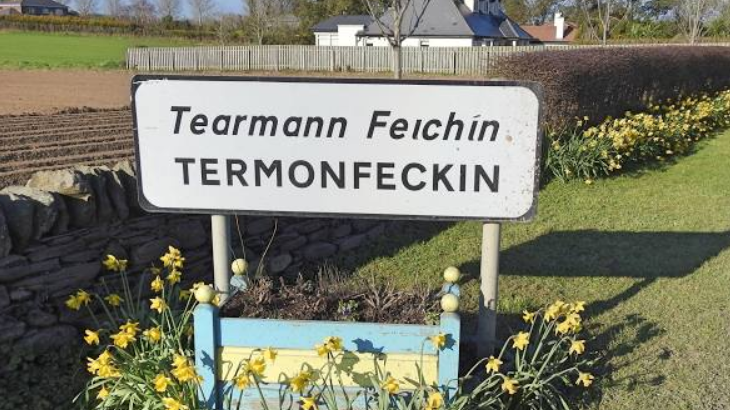
Termonfeckin is a pretty village located 8km from Drogheda in County Louth. Ireland’s smallest county nonetheless carries a dense mix of history, coastline and long established settlements, and Termonfeckin itself has plenty to surprise visitors. Below are some of the most interesting historical landmarks in this history rich village.
Termonfeckin Tower House
Located on the eastern edge of the village, Termonfeckin Tower House is a striking historical feature. A distinctive element of the tower house is its beautifully corbelled roof on the third floor, a very rare architectural solution for tower houses of the 15th and 16th centuries. Researchers have noted similarities between this construction and the corbelled ceiling of the burial chamber in the prehistoric passage tomb at Newgrange. There is a local keyholder, with contact details provided on the gate, allowing visitors to personally experience this unique architectural feature.
Termonfeckin village
The village of Termonfeckin is itself a historical monument, having been founded by St Fechin of Fore as early as 665 AD. From a very early stage, it developed into an important monastic centre. The abbey at Termonfeckin was confirmed by Pope Celestine III in 1195 through papal authority. Traces of its significant ecclesiastical past can almost be felt while walking along the village’s main street. A walk here offers a quiet way to step into a place shaped by more than a thousand years of recorded history.
High Cross at St Fechin’s
Ireland has over 300 high stone crosses. The exact reason for their construction is unknown, though they are believed to have served as a Celtic alternative to continental frescoes, as status symbols, or as markers used to define territory. The high cross at Termonfeckin dates to the 9th or 10th century and is the only surviving element of the monastery founded here by St Fechin in the 7th century. Standing before it offers a rare chance to see biblical scenes alongside dragons and Gaelic ornamental patterns.
Church of the Immaculate Conception
Dating from 1883, the Church of the Immaculate Conception was designed by William Hague and built by Patrick Callan. It was consecrated on 4 August 1883 and has since served as the spiritual and religious centre of the local Catholic community. The church has been central to worship, sacraments and parish life in Termonfeckin and is one of two churches in the parish within the Archdiocese of Armagh.
Church of the Assumption
The Church of the Assumption is the other church in the Termonfeckin parish and is located in the village of Sandpit, just west of Termonfeckin. Built in 1846, it is a Neo Gothic church featuring a tower and a single main hall. Its quieter setting and strong architectural lines give it a character of its own and make it well worth a visit.
An Grianan
An Grianán is a centre offering one day courses in crafts, arts and cooking. It opened as a college and educational centre in Termonfeckin in 1954. While relatively recent in historical terms, the building itself is an elegant 18th century mansion built by the McClintock family. It is a unique place that combines historical value with the opportunity to learn something new in a relaxed atmosphere.
Irish Trader shipwreck
Not as ancient as some of the other sites but still a notable landmark, the coal carrier Irish Trader was wrecked here in 1974 during storms in the Irish Sea. The remains of the ship can be seen on the flat sandy beach between Baltray and Termonfeckin. Although storms and salt water have significantly eroded the vessel’s frame, it remains an important reminder of the destructive power of the sea.
Each of Termonfeckin’s sites adds another layer to the story of the village, from early monastic life to maritime history. Whether you are drawn to medieval stonework, coastal landmarks or quiet village streets, there is plenty to make a visit worthwhile. Pick your favourites from the list and spend a day discovering Termonfeckin’s history in a relaxed and affordable way.